
How to Get Court Records
Start with a Collin County case search to pull the cause number, court, party names, and a likely filing date. Routing comes next. The District Clerk holds felony, district civil, family, and district-court files. The County Clerk and the CCL clerks take Class A and B misdemeanors. They also handle CCL civil suits, probate, and related county-level matters. Each JP keeps its own precinct docket. Every city municipal court keeps its own citation and disposition records.
Collin County offers several ways in. Online Case Search and Case Record Inquiry show public metadata. You can inspect records at a clerk counter or public terminal. You can also mail or email the District Clerk form, submit the County Clerk's online form, or contact the right JP or city clerk. Phone staff can explain routing. The District and CCL offices will not run name searches by phone. Judicial-record requests follow Texas Rule of Judicial Administration 12. Those go to the court custodian, not some unrelated general county office.
- Identify the court and obtain the cause number if possible.
- Name the pleading, order, judgment, or date range sought.
- Choose plain paper, electronic, or certified delivery.
- Send the request to the proper clerk by its accepted channel.
- Confirm fees and wait for the clerk’s completion notice.
Collin District Clerk Requests
Michael Gould serves as Collin County District Clerk. He is registrar and custodian for the 15 District Courts. Visit the records office at 2100 Bloomdale Road, Suite 12132, McKinney, Texas 75071. Mail goes to P.O. Box 578, McKinney, Texas 75070. Call the records line at 972-548-4106 or the main line at 972-548-4320. You can also email dcrecords@co.collin.tx.us. Counter hours run Monday through Friday, 8:00 a.m. to 4:30 p.m.
The request form wants your contact details, the case number, and party names. It also asks for an estimated filing date and up to eight document titles and dates. Delivery options include mail back, pickup, and email. Use a separate form for each case number. Include a postage-paid envelope for mail-back requests. Normal work usually takes one to three days. The form says to allow up to ten business days.
The official District Clerk page explains the records and e-filing roles.
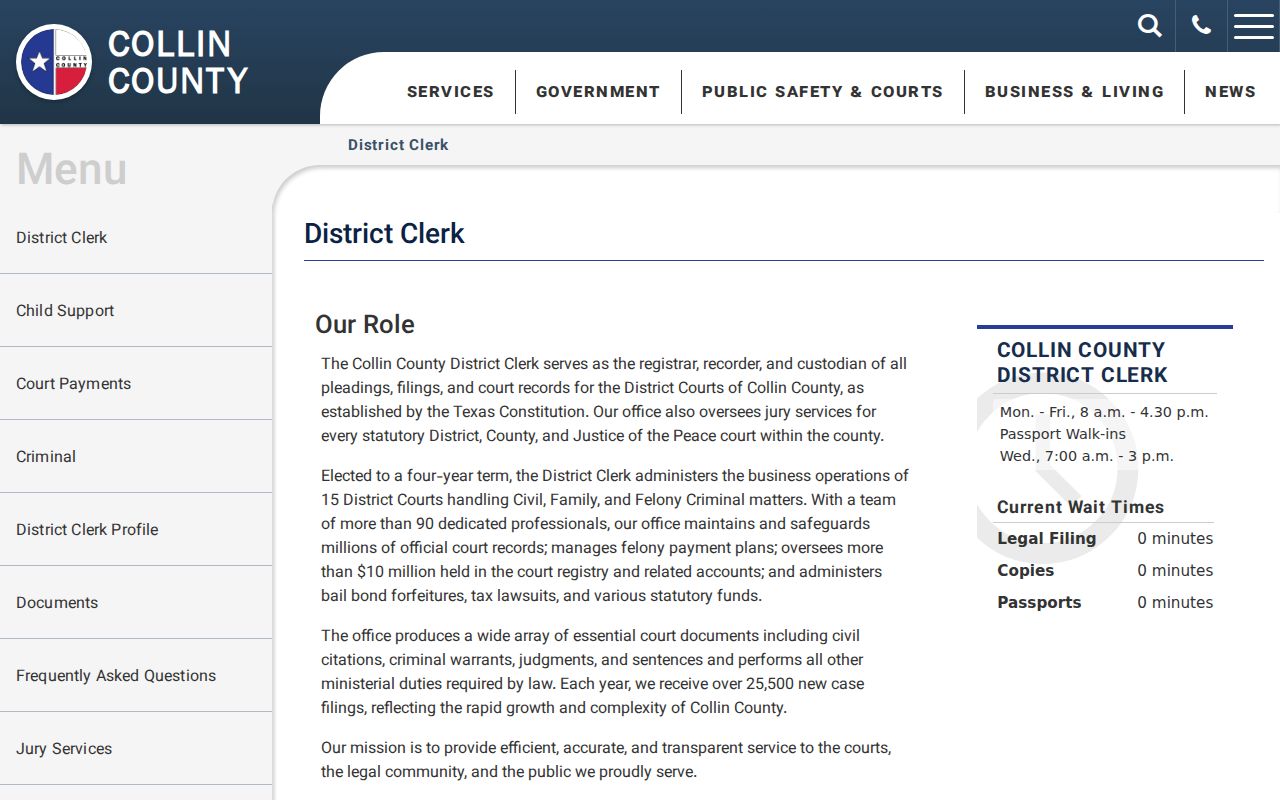
The office page is the current routing source. The written form controls the details of a copy order.
Types of Court Records
A docket is just an index of events. The court file holds the actual material those events recorded. Civil and family files may contain petitions, citations and returns, answers, and motions. They can also hold temporary or final orders, judgments, and appeal notices. A criminal file can include an indictment or information, bond, plea papers, motions, public orders, judgment, and an appeal notice. Protected discovery is not assumed to be public.
Probate files can hold applications, orders, and public inventories where law permits. JP files may include small-claim or eviction pleadings, service papers, judgment, and writ-related entries. Municipal files can hold the citation, disposition or judgment, and deferred-disposition or safety-course paperwork. The Wylie form expressly offers a citation copy and a certified judgment or disposition. Appellate files use a different record set entirely. They include briefs, opinions, and mandates.
Collin County Research Access
The Curt B. Henderson Law Library sits at 2100 Bloomdale Road, Suite 02536, McKinney. It is a public research location. It is not the custodian of every case file, and it does not give legal advice. Its official page lists research help and current contact details. Use the library to understand forms or sources. Then get the actual record from the clerk.
The official law-library page identifies the public research channel.
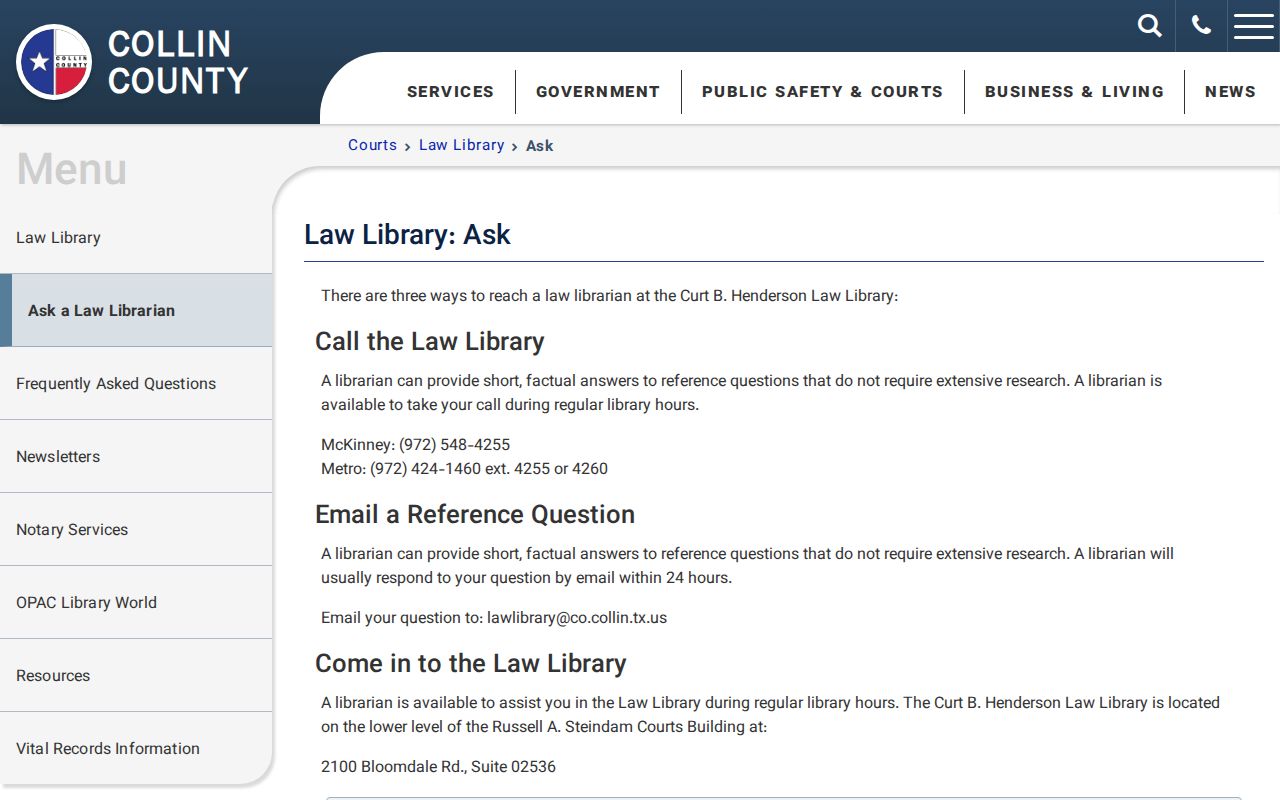
This extra channel helps with record research without blurring the clerk's duty to issue the requested copy.
What a Court Record Contains
What you see depends on the case and the document. A full register may list events without exposing every image. Financial detail appears only if the court publishes it. Sensitive attachments can be withheld. A filing title and date stay public. Use the result to name the exact record you want. Don't ask vaguely for everything.
| Case identity | Cause number, court, case style, category, filing date, and status. |
|---|---|
| Parties | Public plaintiff, defendant, petitioner, respondent, State, and attorney roles. |
| Filings and rulings | Pleadings, motions, notices, signed orders, and judgments. |
| Settings | Dates, times, courtrooms, judicial officer, and setting type where published. |
| Outcome | Dismissal, judgment, conviction, deferred disposition, or other case result. |
| Cross-references | Appeals, transfers, companion matters, or consolidation when recorded. |
A filed request is not a signed order. A hearing setting is not proof the hearing was held. Read entries in date order, and request the document when its wording matters.
Collin Electronic Filing Channel
eFileTexas is the statewide filing and service entry point used in Collin County. It is not a free public record search. Attorneys file electronically for covered matters. These include the mandatory channels the District and CCL offices describe. If you want existing records, use the public portals or the clerk copy process. Don't submit a filing just to seek a record.
The official eFileTexas screen shows the statewide filing service.
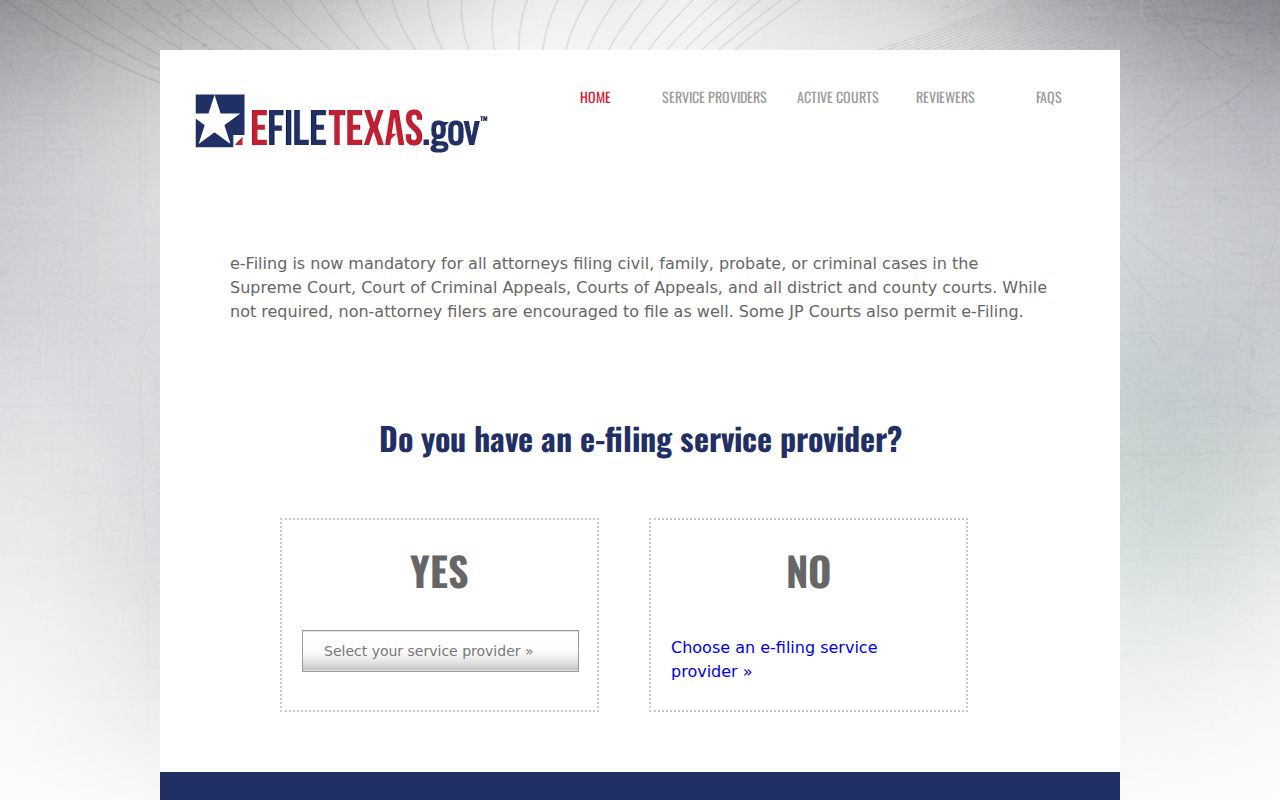
Keeping filing, searching, and copy requests separate prevents a common routing error.
Certified Copies and Fees
A screen view of a Collin County docket helps you follow a case. But it proves nothing. Need official proof? The clerk can certify the copy. The District Clerk's request form covers paper, electronic, certified, and disk options. Pick the one your situation calls for. If you do not know the cause number or the pleading, staff will still search. A $5 search fee comes first. The CCL office sets the same $5 fee for a manual search of older files. It also applies to cases with an unknown cause number.
| Collin County item | Published amount | Key condition |
|---|---|---|
| District noncertified paper | $1 per page | Plain paper copy |
| District electronic | $1 first 10 pages, then $0.10 each | Each additional page or part |
| District certified paper | $1 per page plus $5 | Certificate and seal per document |
| District disk over 100 pages | $20 | Disk option on the form |
| District or CCL manual search | $5 | Cause or pleading unknown |
| CCL paper or electronic | $1 per page; electronic first 10 for $1, then $0.10 | Confirm through current CCL form |
How you pay depends on the office. The District form takes cash, check, money order, or credit card by phone, including Visa, MasterCard, and Discover. Call ahead and confirm the full total before anything is sent.
Collin County Older Files
Not every Collin County record lives online. District criminal files from 1800 through 1987 and civil files before 1984 sit outside the electronic docket, and County Court at Law criminal coverage only begins in 2000. CCL civil records go back further, to 1984. For anything older, the CCL clerks run a manual search. Send a full name, a date of birth where it matters, the case type, and your best guess at the date. Their mail instructions also ask for a self-addressed stamped envelope plus a check or money order.
A blank online result can reflect an archive cutoff, a sealed matter, a different clerk, or a portal delay, not the nonexistence of a record.
Want audio or a transcript? Ask the assigned court or its coordinator what exists and who holds it. One caution: the District Clerk's copy form does not cover a court reporter's transcript.
Public Access and Sealed Records
Texas Rule of Judicial Administration 12 opens judicial records to inspection and copying during regular business hours. Its exceptions and request process still apply. Two other rules shape what stays public. Texas Government Code section 552.0035 keeps judiciary records outside the ordinary Public Information Act treatment that executive agencies face. Texas Rule of Civil Procedure 76a presumes court records are open. It also sets standards for sealing them. Even in open files, sensitive details can be redacted. That includes Social Security numbers, driver-license and passport numbers, bank accounts, birth dates, minors' names, and home addresses. Juvenile files fall under Texas Family Code Chapter 58. So a public docket search may show a restricted label, skip a document, or return nothing at all.
Ask the clerk for the public version or a Rule 12 determination; a search screen does not create authority to bypass a sealing order.
Which clerk should you call? The Collin County District Clerk, County Clerk, JP clerk, or municipal clerk can all walk you through procedure. None of them may give legal advice, though. Whatever record you plan to use for a filing, appeal, or appearance, verify it with the court that issued it.
Collin County District Clerk Records
2100 Bloomdale Road, Suite 12132, McKinney, TX 75071
Records: 972-548-4106 | Main: 972-548-4320
Monday through Friday, 8:00 a.m. to 4:30 p.m.
Collin CCL Record Routing
Where a Collin County case goes depends on its size and type. The County Clerk's form handles misdemeanor A and B matters. It also covers civil suits from $500 through $325,000. Felony, family, child-support, divorce, and larger civil cases belong to the District Clerk instead. You can request CCL records online, in person, or by mail. The address is 2100 Bloomdale Road, Suite 12165, McKinney. Civil questions go to 972-548-6423 and criminal questions to 972-548-6420. Have the numbered court and cause number ready when you call.