
How to Search Criminal Dockets
Begin at the official Collin County Case Information hub. Its broad Case Search covers active District Court, County Court at Law, probate, and justice-court cases. The data refreshes each day at 6 p.m. A known case type can instead be opened through Tyler Case Record Inquiry, which is real time but searches one category at a time. Select Criminal before opening Case Records or Court Calendar.
The strongest key is the cause number. A full name and an estimated filing date also help. For a manual criminal-name search, the clerk asks for the full name and date of birth. Court type matters: a misdemeanor citation may never appear on the felony lane, and a city Class C case stays with its municipal court.
- Read the notice, bond paper, or prior filing for the court and cause number.
- Try county Case Search, then Tyler Criminal Case Record Inquiry for a current result.
- Compare the court, party style, filing date, and charge before accepting a match.
- Check the newest setting and disposition entries, then confirm a live date with the court.
- Use the District Clerk or County Clerk request route for an official copy.
Collin Criminal Docket History
Online history has firm starting points. Collin County District criminal cases are searchable from 1988 forward. County Court at Law criminal history begins online in 2000. Those dates mark database coverage, not the start of the courts or proof that an older case does not exist.
For a District criminal matter from 1800 through 1987, send a manual request to the Collin County District Clerk. Older CCL criminal matters from 1800 through 1999 go through the County Clerk's CCL staff. The District Clerk form asks for the party name, date of birth, case number if known, estimated date, and requested document title. A $5 search fee applies when the cause number or pleading is unknown.
Requests may be delivered at the clerk counter, by mail, or by email where the form permits. Phone staff can route the request, but the office does not perform a name search by phone.
What a Criminal Docket Shows
A full Collin County criminal docket links the stable cause number to the assigned court, State-versus-defendant style, filing date, public charge data, attorneys, settings, and result. It can also list bond events, motions, discovery entries, a plea, judgment, supervision, dismissal, appeal, or mandate. Display varies by system and access rule.
| Cause number | The clerk's stable key for the case. Use the exact number rather than an invented sample format. |
|---|---|
| Charge | The public offense and degree, with the filed complaint, information, or indictment listed as a separate event. |
| Setting | Arraignment, pretrial, docket call, plea, motion, or trial date, subject to later reset. |
| Plea and ruling | A plea entry and a signed order are distinct from a request or motion that was merely filed. |
| Disposition | Dismissal, verdict, judgment, conviction, deferred result, sentence, or other final event when public. |
A docket is not the full case file. A line may name a charging paper while its image must be ordered from the clerk. Likewise, a calendar entry proves a setting was posted, not that the hearing occurred.
Collin Criminal Court Routing
The 15 Collin County District Courts hear felonies, and Michael Gould's District Clerk keeps those records. County Courts at Law 1 through 7 hear Class A and B misdemeanors and authorized Class C appeals. Fine-only criminal and traffic matters may remain in Justice Courts 1 through 4. A city ordinance or Class C state-law case arising inside a city may instead stay with that municipal court.
| Case lane | Docket keeper | First check |
|---|---|---|
| Felony | District Clerk | District criminal search |
| Class A/B misdemeanor | County Clerk / CCL | CCL criminal search |
| Fine-only or traffic | JP clerk | Named precinct |
| City Class C | Municipal court | Named city portal |
An arrest, bond, or magistration can first appear before a JP even when the felony trial cause later belongs in District Court. Follow the court named on the newest notice.
Stages on a Criminal Docket
Chronology gives each line meaning. A complaint, information, or indictment opens the formal charge record. Arraignment addresses the charge and plea. Attorney appearances, discovery, motions, pretrial settings, and docket calls may follow. A plea setting is not a guilty plea, and a motion filed is not an order granted.
Docket flow: Filing › Arraignment › Pretrial › Plea or Trial › Disposition › Sentencing
Later entries may include probation or supervision, a dismissal, notice of appeal, and appellate mandate. Read the most recent entry and the signed judgment when the result matters. Collin appeals move to the Fifth Court of Appeals in Dallas.
Collin CCL5 Morning Docket
County Court at Law 5 supplies a concrete example of local docket control. Its published criminal policy sets Tuesday through Friday docket hours from 8:30 to 11:30 a.m. Plea paperwork is cut off at 11:30. The policy treats a no-show as no appearance and warns that bond may be forfeited.
This is a CCL5 rule, not a rule for every Collin County criminal docket. Counsel with a next-day conflict is told to contact the coordinator so a reset or pass can be addressed. The policy also describes a plea setting about 90 days after the first-appearance phase and attorney appearance, with an initial offer and discovery expected from the State.
Always check the assigned court's current order. A time printed in one court's policy does not transfer to another CCL or District Court.
Which Court Holds Criminal Dockets
The court level determines both the docket keeper and the copy route. District Clerk records staff can be reached at 972-548-4106, with the main office at 972-548-4320. The CCL criminal desk uses 972-548-6420 or 972-548-6422. Each of the seven CCL courts also has a direct clerk line.
Justice and municipal courts keep their own fine-only records. Check the citation or setting notice for the precinct or city. Court coordinators can confirm a live setting, while clerks handle docket access and copies. Neither role should be asked for legal advice.
The county portal is a locator. The responsible clerk remains the source for an official case record, and a court reporter or coordinator is the route for a transcript or audio record.
Collin Criminal Docket Channels
Use more than one channel when a result is missing or stale. Judicial Online Search is the broad daily search. Tyler Criminal Case Record Inquiry is the real-time, one-type lane. re:SearchTX adds statewide case, filing, document-text, and hearing tabs through an account path, but it does not guarantee every Collin file is indexed or public.
Older records and certified copies require the District Clerk or CCL counter, public terminal, or written request. District requests can use mail or email. CCL records use the County Clerk form or mail. A direct court line is best for a current setting. JP and municipal clerks cover cases that never entered the county criminal database.
The official County Court at Law clerk page shows the local misdemeanor route. Its view also illustrates why the clerk lane matters.
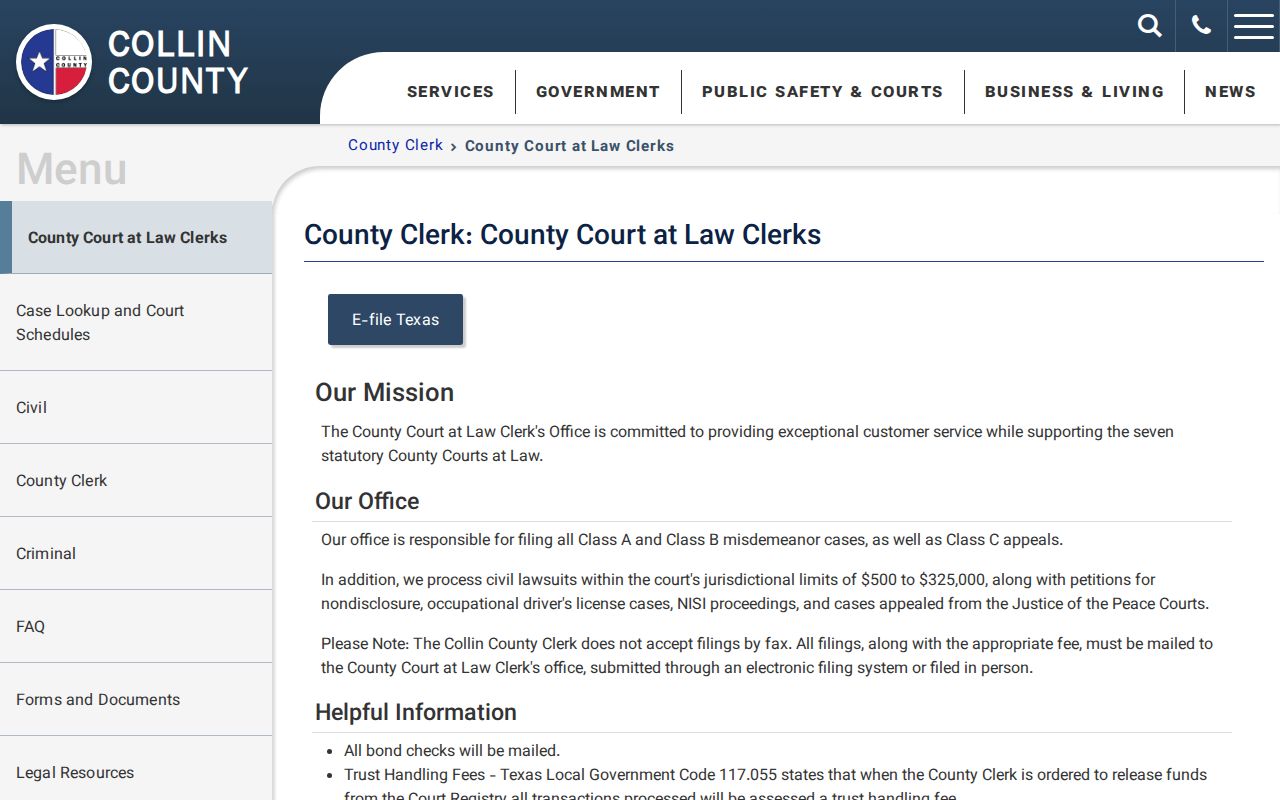
The page connects CCL jurisdiction, clerk contacts, manual search instructions, and the route for copies behind a criminal docket.
Public Access to Criminal Dockets
Texas court records are generally open, but public access has limits. A Collin County criminal docket may show a filed title and date while an attachment is withheld or redacted. Social Security numbers, driver-license and passport numbers, account data, birth dates, minors' names, and home addresses receive protected treatment. Juvenile records follow a separate confidentiality scheme.
Key rules:
Texas Rule of Judicial Administration 12 sets the judicial-record request and exception framework.
Government Code §552.0035 explains why court access follows judicial rules and other law instead of the ordinary agency process.
Texas Family Code Chapter 58 governs special confidentiality and sealing rules for juvenile records.
Ask the responsible clerk for the public version or a Rule 12 determination. A sealed or omitted item is not proof that no case exists, and public access does not authorize bypassing a court order.